
Reduce harm
Minimize negative impact, meet compliance thresholds, and manage downside risk across environmental and social dimensions.
Regenerative Business Protocol
RBP is a research-grounded assessment framework, originally developed through research at Stanford, now used by founders, ESG leaders, and business stakeholders to understand where their organization stands on regenerative and ESG maturity, and what to work on next.
Assessment items were developed and validated by a panel of experts across sustainability academia, venture capital, ESG law, and public health, giving the framework rigor beyond a single perspective.

The Regenerative Business Protocol at a glance
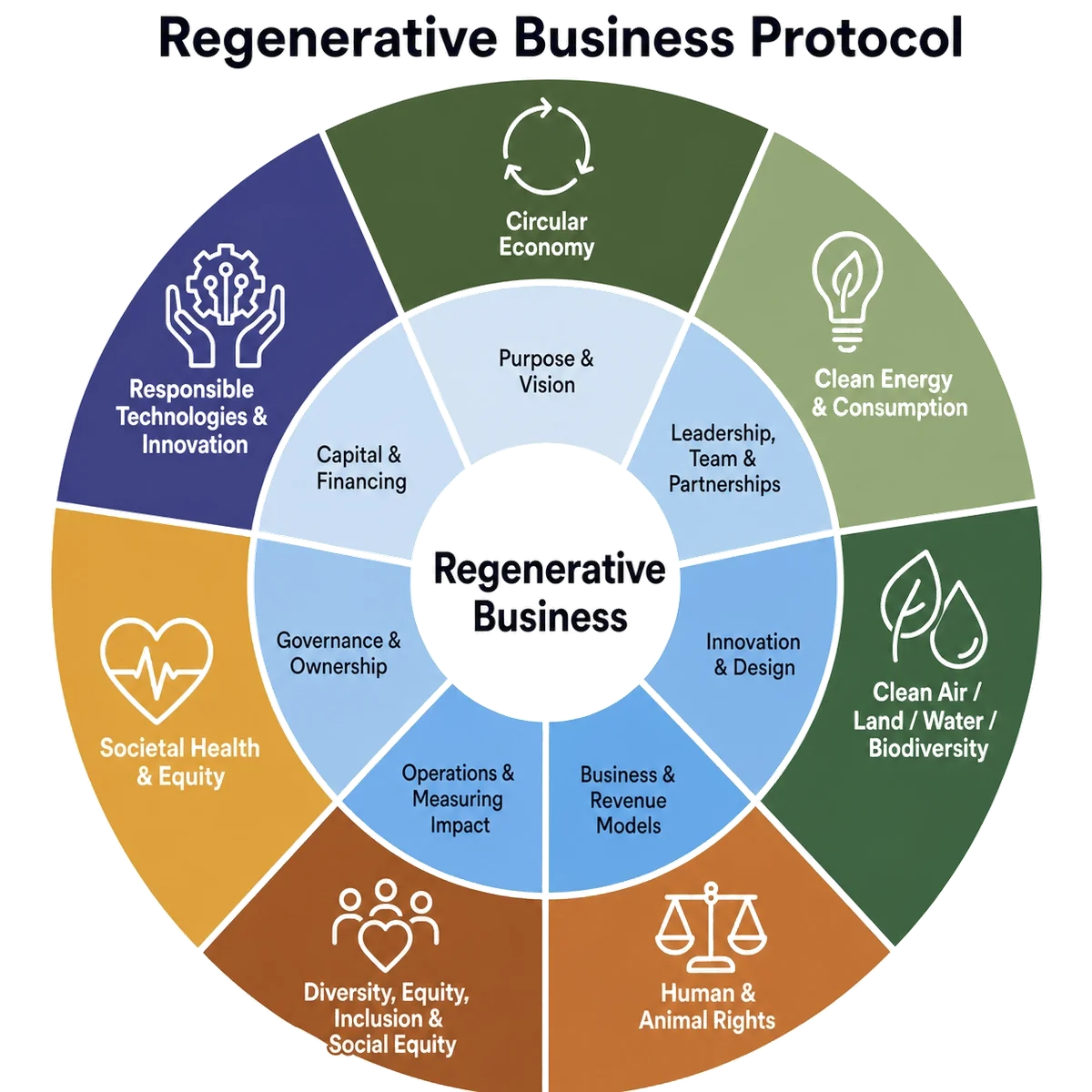
Large corporations have dedicated teams and budgets for ESG and sustainability. Most businesses, from early-stage startups to established SMEs, don't have that luxury.
They still need a clear, credible way to understand where they stand and what to do next. RBP closes that gap: a structured self-assessment plus a tailored maturity report, grounded in research and designed to fit around your schedule.
Regenerative vs. sustainable
Sustainability aims to reduce harm and minimize negative impact. Regeneration goes further: a regenerative business gives back more than it takes, actively strengthening the people, communities, and natural systems it touches.
RBP is built to measure genuine net-positive regenerative maturity, not just risk mitigation or compliance. It looks at where your business is contributing more than it consumes, and where there is still work to do.
Minimize negative impact, meet compliance thresholds, and manage downside risk across environmental and social dimensions.
Actively restore and strengthen the people, communities, and natural systems the business touches, creating measurable net-positive impact.
Beyond standard ESG
Alongside the familiar Environmental, Social, and Governance pillars, RBP adds two dimensions that increasingly define what it means to be a regenerative business, and that most ESG frameworks overlook.
How the business affects the health and wellbeing of the communities it operates in, including who benefits, who is left out, and how equitable access is designed into products, workplaces, and supply chains.
How the business develops and deploys technology, including how AI is used responsibly across products, operations, and decision-making, with attention to transparency, bias, and long-term impact.

Why this matters now
Large companies are increasingly required to report on their supply chain's sustainability performance, including Scope 3 emissions and broader ESG data. That means small and mid-sized businesses are now being asked by their customers and partners for this information, often with short deadlines.
RBP is a way to get ahead of it. Understand your own maturity, identify where you have credible answers today, and see where to invest next, so you are ready when the request lands rather than scrambling to respond.
How it works
A structured questionnaire covering 97 items across 14 pillars. Roughly 45 to 60 minutes total, split into sections you can complete at your own pace across multiple visits. Progress saves automatically.
An instant maturity report and prioritized action plan, tailored to your industry, size, and current stage.
Request a conversation to talk through your results and next steps with someone from the RBP team.
Explore
A short taster of the assessment. Answer 10 questions and get an instant snapshot.
OpenHow companies are actually scoring on the framework. Anonymous, aggregate results.
OpenEvery pillar in the framework, with the assessment items behind it.
OpenRegenerative businesses to learn from, and lessons from failure.
OpenWhere RBP comes from, how the 14 pillars were derived, and how scoring works.
OpenShort essays on ESG shifts and what to prepare for next.
OpenCommon questions on the assessment, scoring, privacy, and teams.
Open97 items across 14 pillars, roughly 45 to 60 minutes in total. Complete it in sections at your own pace, with progress saved automatically so you can pick up where you left off.